Showing posts with label wonders in the dark. Show all posts

The Lives of Others

#66 in Best of the 21st Century?, a series counting down the most acclaimed films of the previous decade.

Hauptmann Gerd Wiesler (Ulrich Mühe) is a top Stasi agent, not the kind whose flashy skills and pride draw attention to himself, but the kind who quietly and methodically does his job, never questions authority, and seems to actually believe in the principles he operates under – or at least has never given them enough thought to really object. Then again, it’s hard to tell; the very reticence which makes him an ideal snoop and a hard-to-read interrogator means that we can’t quite be sure what’s going on in his mind: is he a loyal soldier, or merely someone who knows his place? German director Florian Henckel von Donnersmarck’s debut film, the 2006 winner for Best Foreign Film, The Lives of Others is about Wiesler’s slipping grasp on his own stoic rigidity, internal and consequentially external as well. The suggestive title conflates state-sanctioned snooping with sympathetic voyeurism, and indeed as Wiesler spies on a bourgeois artist couple, playwright Georg Dreyman (Sebastian Koch) and actress Christa-Maria Sieland (Martina Gedeck), his impassive surveillance gives way to emotional involvement – eventually one will have to give in to the other. Village Voice critic J. Hoberman has astutely noted the similarity to Wim Wenders’ seminal Wall- era Wings of Desire, writing, “No less than Bruno Ganz’s empathetic seraphim, Wiesler longs to be human.” Indeed, after listening in on a robust lovemaking session, Wiesler orders himself a home visit from a busy (and buxom) prostitute; though perhaps physically satisfying, it doesn’t quite scratch the spiritual itch Wiesler has been developing. Perhaps more telling is an encounter on an elevator just prior. A little boy, bouncing a ball casually asks Wiesler if he’s “really Stasi”; asked if he knows what this even means, the boy inadvertently informs on his father’s bilious characterization of the secret police. “What is the name of your f-” Wiesler stops himself, and pauses: “…of your ball?” The little boy chuckles and runs off, not knowing how close he came to turning the old man in. And Wiesler probably wonders what possessed him to show mercy, a quality he may not even have realized was within his power until now.

Continue Reading »

The Gleaners & I


by Joel Bocko

#59 in Best of the 21st Century?, a series counting down the most acclaimed films of the previous decade.
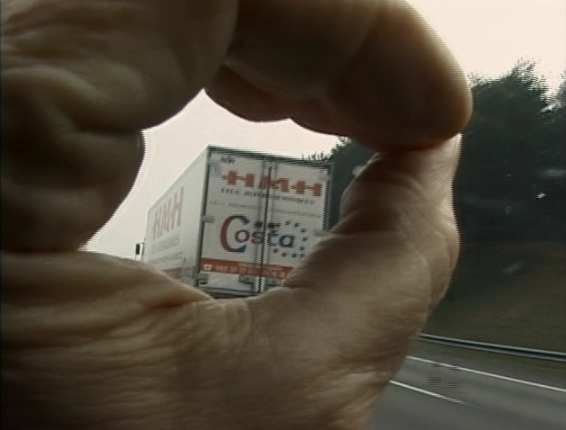
"Again one hand filming the other hand, and more trucks. I'd like to capture them. To retain things passing? No, just to play.
In Agnes Varda's documentary The Gleaners & I (a more literal translation from the French would be "The Gleaners & The Gleaner", or even "Gleaneress") play, investigation, and contemplation are all intricately yet loosely wound together - each element distinct yet forming an upretentiously ambitious whole, much like the found-object artpieces Varda highlights throughout. Her subject, as you might have gathered (no pun intended), is gleaning: in all its forms. We are introduced to the classical gleaners, the peasant women who would follow the harvest by crouching and stooping through the fields, rummaging for leftovers once the more illustrious agricultural bounty was carried off. We see such gleaners in famous French paintings, and meet one or two who reminisce only - it seems that this more traditional form of gleaning has fallen by the wayside: mechanized reaping has become too precise and so few crops are left behind these days. This we learn in the first five minutes of the 90-minute film; what follows is an eager, inquisitive investigation of gleaning in all its latter-day manifestations...

Continue Reading »

L'Enfant

#57 in Best of the 21st Century?, a series counting down the most acclaimed films of the previous decade.

You’re about halfway through L’Enfant when you realize whom exactly the title refers to. Sonia (Déborah François) has just had a baby boy, and when the movie opens, she’s seeking the child’s father. He’s not at his apartment, which is occupied by a surly couple who slam the door in her face (a gesture that will be repeated throughout the film, although eventually she’s the one doing the slamming). When she finds him he’s on the street, wandering between cars stalled at a stop light, begging for change. Bruno (Jérémie Renier) is a scruffy young man, who could be anywhere from mid-twenties to early thirties. The indeterminacy of his age is telling; while his thick features suggest a manliness, his mop of hair, puppy-dog eyes, and perpetually mischievous grin suggest perpetual boyhood. Though Sonia is clearly his junior, she manages to mix a girlish playfulness (she’s constantly goofing around with Bruno, amidst shrieks of laughter) with a motherly concern for her new charge. Bruno, on the other hand, as soon as he’s left alone with the baby, tries to sell his own son.

Continue Reading »

Tropical Malady

#55 in Best of the 21st Century?, a series counting down the most acclaimed films of the previous decade.

We’ve heard that love’s a bitch, and a battlefield, but in the 2004 Thai film Tropical Malady, writer/director Apichatpong Weerasethakul tells us it’s a tiger too. Or at least that’s one interpretation. Actually, at times it can be hard to know exactly what Apichatpong is after. As with the filmmaker’s later Syndromes and a Century (reviewed in a previous incarnation of this series), Tropical Malady divides neatly into two halves, but the way the halves relate to each other is different. In Syndromes, the different parts of the film are symmetrical, like parallel lines – they relate similar events in radically different surroundings. Malady on the other hand connects it’s first and second half with a joint and then lets them spin in entirely different directions, until the thread connecting them seems stretched awful thin. The two halves are perpendicular rather than parallel – maybe they’re better considered as two separate films, but here they are presented together, their interconnections left for us to tease out.

Continue Reading »

100 Classics of Silent Cinema

Allan Fish has today concluded his ambitious countdown of the one hundred best films from the early years of cinema. You can catch up with the full selection here and read his entry on the #1 film here. Don't forget to take the poll either - myself, I'm working double-time to catch up with and re-watch classic silents over the next two weeks so I can feel up to participating. But even if you don't have time for reappraisals or first-time screenings, let your voice be heard! The more the merrier.

Apropos of nothing, my review of Greenberg will be up on Lost in the Movies later today, linked here tomorrow. And by the way, merry Palm Sunday - as a lapsed Catholic, I fondly recall this holiday. I always enjoyed the theatrics of reading the liturgy aloud in church, and of all those palm fronds waving in the air.

Elephant

#51 in Best of the 21st Century?, a series counting down the most acclaimed films of the previous decade.

Of the two most cited interpretations, the most frequent reading of Gus Van Sant’s enigmatic title holds that it refers to “the elephant in the room,” which nobody wants to talk about. Yet this is facile – was it really true that nobody wanted to talk about Columbine in the wake of the 1999 high school massacre? Was this true even beforehand, given that Columbine was actually the climax to a spate of school shootings, all of which received ample press coverage, rather than the kickoff? Furthermore, what exactly is it that’s not being discussed? Social isolation? The influence of the media? Video games? Gun control? Violence in America? Not only were all of these issues seized upon after the killings, but Van Sant makes a point out of eschewing all these explanations in his film (giving each of them a bit of airtime before moving on to other matters). So no, there’s no elephant in the room here, and if there is, no one’s ignoring it. The second reading, the one that it seems Van Sant actually intended, references the allegory of the blind men and the elephant, each touching a different part of the body and varying wildly in how they describe the animal. Likewise, Van Sant’s meditative, almost cruelly cool film is, at 81 minutes, too vast to take in from one perspective – which is not to say it’s particularly deep.

Continue Reading »

And then there were 10...

Today on Wonders in the Dark, Allan Fish kicks off the final stretch of his ambitious Top 100 silents countdown with The Battleship Potemkin at #10. What movies will fill the final nine slots - especially with such classics as Pandora's Box, Intolerance, The Gold Rush, and The Birth of a Nation already accounted for? Be sure to visit and found out, as the countdown finishes over the next week and a half. And don't forget to vote in the poll for your own picks.

To catch up with the rest of the selections (including the top 25 for the 30s, and the top 50 for every decade since - except for the one just passed, which Allan will be tackling next), visit the round-up on my blog.

Summer Hours


[#48 in Best of the 21st Century?, a series counting down the most acclaimed films of the previous decade.]
_________

“So we beat on, boats against the current, borne back ceaselessly into the past.”
_________

“I took her hand in mine, and we went out of the ruined place; and, as the morning mists had risen long ago when I first left the forge, so, the evening mists were rising now, and in all the broad expanse of tranquil light they showed to me, I saw no shadow of another parting from her.”
_________

“Poor Mole stood alone in the road, his heart torn asunder and a big sob gathering, gathering, gathering, somewhere low down inside him, to leap up to the surface presently, he knew, in passionate escape. … Meanwhile, the wafts from his old home pleaded, whispered, conjured, and finally claimed him imperiously. He dared not tarry longer within their magic circle. With a wrench that tore his very heartstrings, he set his face down the road and followed submissively in the track of the Rat, while faint, thin little smells, still dogging his retreating nose, reproached him…”
. . . . .

Summer Hours, The Decline and Fall of the French Bourgeoisie, Three Generations. Olivier Assayas’ absorbing and poignant film is first an observation of life’s fleeting moments (one might say it’s more observant than the characters who experience these moments, without really appreciating them). It is also a wailing elegy to a France crumbling away in the globalized world, letting its culture and its people dribble from its borders like sand from a smashed hourglass. And finally the movie is a portrait of one family, three generations (old, middle-aged, young) and three siblings in that middle group (brother, sister, brother), who slowly and willingly lose their country home, and with it their fragile communal identity. These two triumvirates, the generations and siblings, are each anchored in the center – chronological in the case of the age group (those in the middle of their life dominate the running time of the film), geographic in the case of the brothers and sisters (the deceased matriarch’s eldest son lives in France and tries to hold the family together, while his sister flees west to New York, and his little brother flees east to China). Alas, as is so often the case, the center does not hold.

Continue Reading »

Still Life

First things first, it’s very hard to capture the life of Still Life in a still. There were numerous images that caught my eye while watching the movie, and when it was over I tried to go back and pause certain moments to create a screen-capture on my computer. No dice, though I finally settled on the enticing image seen above. The problem was that all of these impressive visuals contained the essential value of movement, either of the camera, within the frame, or both. One particular sequence seemed ripe for pictures: a quiet scene in which characters dance on a rooftop at dusk, with the half-constructed metropolis blazing in the background and a yawning, unilluminated bridge stretching towards the hilly horizon. Yet each time I paused the simple panning motion, the still did not capture that visceral pull of the visuals, the interruption of a simple sweep somehow stripping the shot of its power.

Continue Reading »

Oscar round-up

A round-up of Oscar reviews is up at Wonders in the Dark.

The Hurt Locker


Two pictures to sum up a decade. One, a man encased in defensive armour, surrounded by explosive cannisters. He's a stranger in a foreign land, an embattled American, homemade bombs weaving a spiderweb in the desert sands beneath his feet. The devices are all aimed in his direction like gigantic bullets, together forming a silent threat simmering just underneath the surface. Two, a man in a cavernous, overwhelming, colorful yet utterly sterile supermarket, faced down by hundreds upon hundreds of cardboard boxes, each containing processed and mass-produced snacks. More significant than the contents is the packaging - this is nutrition second, consumption first, and an empty, dissatisfying consumption at that. The bombs are existential threats; the boxes are not, and yet somehow their spiritual threat seems deeper. As Jason Bellamy astutely notes (in an observation which inspired the pictures and paragraph which open this piece), "In staring at all the cereal boxes on the shelf, he is presented with a multitude of choices, just as when he's disarming a bomb, but his choices don't mean anything. There's no 'wrong' choice. It's a reminder of how he misses the rush of duty, when every decision has a potentially life-altering consequence."

Pick your poison. Sgt. William James has certainly picked his.

Read more »

(This piece is cross-posted on Wonders in the Dark, where the rest of the "Best of the 21st Century" series will be exclusively unfolding.)

Best of the 21st Century?

 
The "Best of the 21st Century?" series has been re-booted and re-launched on Wonders in the Dark. The first review will be of The Hurt Locker, cross-posted on Wonders and Lost in the Movies one week from today. For now, there's a new list and a new intro.


A review of Invictus will be up on Lost in the Movies later today, with another film reviewed early tomorrow . Also, in case anyone missed it, I tackled Up in the Air yesterday, on the same site.

The Overriding Importance and Value of Professional Film Criticism


With that title, Sam Juliano kicks off a passionate defense of critical tradition as well as a trenchant and at times contentious debate about the merits of amateur criticism vs. professional criticism. There couldn't be a more pertinent topic to tackle within the blogosphere, and I hope you all check out both the post and the discussion. I'm sure it will continue in days to come so don't feel discouraged if you come to this a few days late. My own thoughts are shared in the thread.

What's up...

A few updates are in order. Firstly, I attached a brief addendum to the opening of my "End of the Examiner" announcement on Wonders in the Dark. It's worth reprinting here in full:
(disclaimer 2/5: I’ve slightly modified the piece and want to issue a clarification at the outset – whatever my issues and disagreements with the site, the experience was largely a positive one. The post is not intended to be a critique of the Examiner, but rather an explanation of my new direction.)
Secondly, I wanted to point your attention to my previous piece on The Sun's Not Yellow (the one topped with the Wizard of Oz pic). In a sense I buried my lead but it was supposed to be more of a discussion-starter than a stand-alone musing, in which I posed the question of whether or not mass re-discovery of classics was possible, and particularly if any of you could think of any candidates for the type of re-discovery that Wizard of Oz and It's a Wonderful Life enjoyed. I'd hoped to see some back-and-forth on that subject, but maybe you're all as stumped as I was. So far only Adam Zanzie's bitten (and even he had trouble thinking of examples outside of scholarly circles). Come one, come all.

Finally, I've updated and streamlined an old post on The Dancing Image. It originally appeared on the site last summer, as a round-up of all my work on that site. Ironically, it preceeded a drop-off in postings there, so that it has not been updated much in the past six months. This weekend I linked up to all my writing online, not just for that particular blog. It now serves - and will continue to serve - as a master directory for all my online work. Comments on old pieces are always welcome.

Here's the directory.

With all that out of the way, I've a number of projects on the back-burner though as always my no-resolution resolutions keeps me silent on what exactly (not that I haven't frequently tipped my hand in the past). Stay tuned, as The Sun's Not Yellow should continue its steady output in the coming week with hopefully more on the horizon for other sites throughout February.

P.S. Check out Stephen's skewering of the sacred Citizen Kane - a film I adore, yet I thought his takedown a bravura piece of analysis. Read, recoil (or rejoice), and respond here.

End of the Examiner

I've left the Examiner and moved of all my pieces elsewhere. The announcement, as well as links to the reviews and features in their new homes, is up at Wonders in the Dark.

A Christmas Tale (& other stuff)

My review of A Christmas Tale is up in time for the holidays at Wonders in the Dark. So head over there to share your own thoughts on the film. Here's some more entries which have gone up recently:

Syndromes and a Century

Kings and Queens (from the director of A Christmas Tale)

Merry Christmas to all applicable...(and a happy new year to all & sundry...)

Antichrist

My review of Antichrist is up.

Capturing the Friedmans

My review of Capturing the Friedmans is up.

Flight of the Red Balloon

My review of Flight of the Red Balloon is up.